Advanced Strategies — Late-Game Optimization & Speedrun Tactics for EggOS
Once you have paid off the bank for the first time, EggOS transforms from a survival scramble into an optimization puzzle. This page covers late-game routing, prestige tree completion, and speedrun tactics for players who want to clear the million-dollar debt in record time on every subsequent loop.
Understanding the Post-Victory Loop
Beating the bank once is the tutorial; the real game begins when you reset and do it all again, faster. Each fresh loop starts you back at the EggOS desktop with your debt restored, but the prestige upgrades you have unlocked carry forward, permanently reshaping your early game. The core of late-game play is treating every run as a routing exercise: knowing exactly which apps to open, which games to ship, and which upgrades to buy in the opening minutes so that no income source sits idle.
Experienced players think in terms of income phases rather than individual actions. The early phase of a loop is dominated by manually coding and shipping games, the mid phase by layering in dart-throwing, slot machines, and other mini-games as supplementary streams, and the late phase by letting compounding upgrades do the heavy lifting. The faster you can push a run through each phase transition, the faster the debt falls. Identify the exact moment in your runs where manual play stops being the bottleneck, and restructure your prestige purchases to pull that moment earlier.
Prestige Tree Completion Strategy
The prestige tree is deep enough that full completion takes many loops, so the order in which you fill it out matters enormously. As a general rule, prioritize nodes that accelerate the opening minutes of a run — anything that boosts your baseline game-development income or reduces early friction pays dividends on every single subsequent loop. Upgrades that only shine in the late game can wait, because by the time they become relevant, a well-routed run is usually already closing in on the bank anyway.
When working toward one hundred percent completion, resist the temptation to spread prestige currency evenly across the tree. Deep branches often gate their strongest effects behind several prerequisite nodes, so committing to one branch at a time gets you to the powerful capstone effects sooner. Once your core money-making branch is finished, circle back for the quality-of-life and side-activity nodes that make full-completion runs comfortable rather than fast.
Completionists should also plan around the loop structure itself. Some tree progress is best earned by deliberately extending a run past the point where you could beat the bank, farming additional resources before resetting. Decide before each loop whether it is a speed loop, meant to end the instant the debt clears, or a farming loop, meant to maximize prestige gains — mixing the two goals mid-run usually accomplishes neither efficiently.
Speedrun Routing on the EggOS Desktop
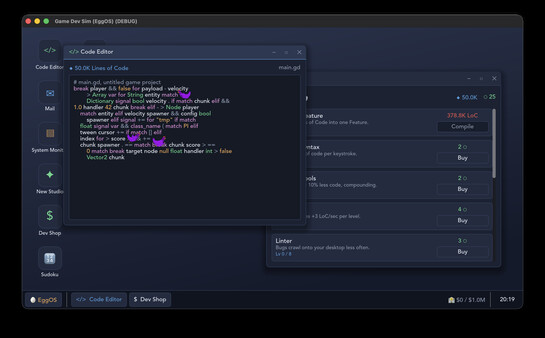
Because EggOS is a playable fake desktop, raw execution speed matters: window management is part of the run. Speedrunners learn a fixed opening sequence — which applications to launch, in what order, and how to arrange them so no click is wasted. Every second spent hunting for an icon or shuffling windows is a second the debt timer keeps ticking, so practice your desktop setup until it is pure muscle memory.
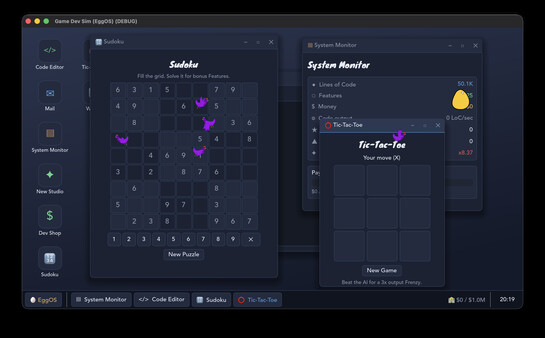
Routing decisions revolve around overlap. The strongest runs never let a single income source be the only thing happening: while a game is being developed, you should be interacting with darts, slots, or another mini-game rather than watching a progress bar. Map out which activities demand active attention and which run passively, then interleave them so your hands are always working on the highest-value active task while passive systems tick along underneath.
Finally, learn your kill point. A speedrun of EggOS ends the moment the bank is paid, so every purchase in the final stretch should be evaluated purely on whether it shortens time-to-million. Late in a run, upgrades that would be excellent in a long farming loop are often dead weight in a speed loop — banking the cash directly toward the debt is frequently the faster play.
Optimizing the Gambling and Mini-Game Layer
The slot machines and dart-throwing games are more than flavor — in optimized play they serve as burst-income and downtime-filler tools. Slots introduce variance, which speedrunners can exploit: on a speed loop, a lucky streak early can catapult you past an entire income phase, and since a bad run can simply be reset, aggressive gambling early is often correct for record attempts. On consistency-focused or farming loops, treat gambling more conservatively and lean on the steadier game-development income instead.
Dart-throwing and the other skill-based mini-games reward actual player execution, which makes them one of the few places where personal practice directly translates to faster times. Grind these games outside of serious attempts until your accuracy is reliable, because a skilled player extracts noticeably more value per session than one relying on luck. Slot in mini-game sessions during natural lulls — moments when your development pipeline is busy and there is nothing better to click.
Common Late-Game Mistakes
The most common error among experienced players is over-investing in a comfortable mid-game. Upgrades that feel satisfying — smoother automation, bigger passive trickles — are not always the ones that shorten runs. Audit your purchases after each loop: if an upgrade did not measurably move the moment you paid the bank, cut it from your route and spend earlier on something that does.
Another frequent mistake is refusing to reset. Because prestige power compounds across loops, a run that has gone slightly stale is usually worth abandoning in favor of a fresh, better-routed attempt rather than grinding it to a slow finish. The players who complete the prestige tree fastest are the ones who treat individual runs as disposable experiments, keeping what works, discarding what does not, and always asking how the next loop can beat the bank a little faster than the last.