All Upgrades & Unlocks — Complete Progression Breakdown for EggOS
EggOS: Incremental Game Dev tasks you with paying off a $1,000,000 bank debt by making games inside a playable fake desktop, and nearly every dollar you earn flows back into upgrades, automation, and a permanent prestige tree. This page catalogs the game's major upgrade categories, unlock milestones, and a recommended order for investing your resources across a run.
Core Production Upgrades: Lines of Code and Features
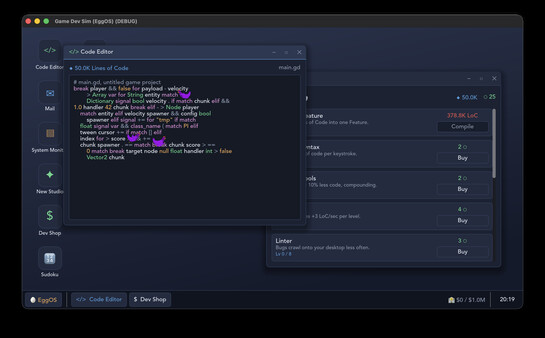
Everything in EggOS starts with the Code Editor, where hammering the keyboard generates Lines of Code — the game's base resource. Early upgrades in this category focus on increasing how much code each keystroke produces, following the classic incremental loop: manual action first, multipliers second, automation last. Because Lines of Code feed every downstream system, these upgrades are almost always the correct first purchases in a fresh run or a fresh prestige.
The second tier of production is the Dev Shop, which compiles your raw Lines of Code into Features. Features are the intermediate resource that actually goes into the games you build and ship, so upgrades that improve compile output or reduce the code cost per Feature effectively multiply your entire income pipeline. A common mistake is over-investing in raw code generation while leaving compilation as a bottleneck — check which resource is capping your progress before buying.
As a rule of thumb, alternate purchases between the two layers: buy code-generation upgrades until Lines of Code accumulate faster than the Dev Shop can consume them, then shift spending into compilation upgrades until the balance flips back. Keeping the pipeline balanced is worth more than maxing either layer in isolation.
Automation Unlocks: Coding AI and Auto-Compiler
Automation is the turning point of every EggOS run. The Coding AI is the headline unlock here — once purchased, it writes Lines of Code for you continuously, converting the game from an active clicker into a true idle experience. Prioritize reaching this unlock early: every minute spent before automation is a minute of purely manual income, while every minute after it compounds even while you're doing something else on the desktop.
The Auto-Compiler is the matching automation for the Dev Shop, turning code into Features without your input and, as the game puts it, never sleeping. Together with the Coding AI it completes the hands-free pipeline from keystroke-equivalent to shippable game content. Once both are running, your role shifts from generating resources to allocating them — buying the next multiplier, playing the desktop mini-games, and preparing your game for shipping.
Automation also underpins EggOS's offline and idle progress: the work keeps going while you're away. This makes automation upgrades disproportionately valuable compared to same-cost flat multipliers, since they earn during time you would otherwise not be playing at all. When in doubt between an automation unlock and a numeric boost of similar price, take the automation.
Desktop Apps and Mini-Game Unlocks
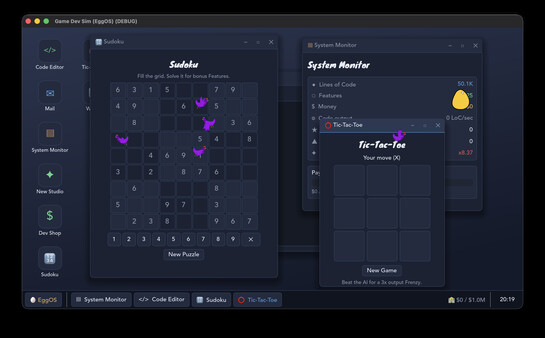
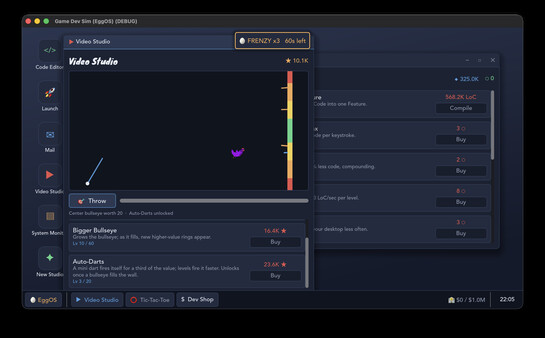
EggOS is framed as a full fake operating system, and progression gradually opens up new desktop apps beyond the Code Editor. The dart-throwing and slot machine mini-games are the most notable of these side activities, giving you something active to do while your automated pipeline grinds in the background. Treat them as supplementary income and variety rather than your primary earner — the core code-to-Features loop remains the backbone of debt repayment.
The slot machine in particular is a gamble by design: it can accelerate a run when luck cooperates, but it should be fed with surplus cash rather than money earmarked for your next key automation or production upgrade. Dart-throwing rewards active play sessions, making it a good use of attention during stretches where your next pipeline upgrade is still far off.
Each new app unlock is also a soft milestone marker — if a tool or mini-game has just opened up, it generally means your economy has reached the scale the game expects for that stage. Use these unlocks as a pacing check: falling far behind the apps you've opened usually means an upgrade tier in the core loop has been neglected.
Shipping Games and the Road to $1,000,000
The overarching goal of a run is to build and ship games, converting your accumulated Features into the money the bank demands. Shipping is the endpoint of the production pipeline, so every upgrade described above — code output, compile efficiency, automation — ultimately exists to make each shipped game bigger and faster to produce. Reinvestment is the core rhythm: revenue from one game funds the upgrades that make the next one cheaper and quicker.
The $1,000,000 foreclosure threat serves as the run's victory condition and pacing device. Early in a run, most income should go straight back into the upgrade economy rather than sitting toward the debt, because multipliers compound while banked cash does not. The debt payment itself is best treated as the final conversion of a fully upgraded economy, not a savings goal you chip at from minute one.
Beating the bank is not the end of EggOS — it's the trigger for the game's meta-progression. Finishing a run sets up the prestige system, and the game is explicitly built around clearing the debt repeatedly, faster each time.
Prestige Tree: Permanent Multipliers and Recommended Order
Starting fresh after a run earns Prestige points, which are spent on a sprawling skill tree of permanent bonuses. These fall into three broad families: flat multipliers that boost production across all future runs, head-starts that skip or accelerate the slow manual opening of a run, and game-changing perks that alter how systems work. Unlike in-run upgrades, everything bought here persists forever, making the prestige tree the game's true long-term progression.
For early prestige investments, head-starts and early-automation perks tend to deliver the most felt value, because the pre-automation phase is the slowest and most manual part of any run. Compressing or skipping that opening means each subsequent run reaches its compounding phase sooner. Broad permanent multipliers are the reliable follow-up, scaling every layer of the pipeline at once, while narrower game-changing perks are best evaluated against your personal playstyle — active players and idle players will rank them differently.
The intended loop is deliberate: ship your game, beat the bank, prestige, and do it all again faster. Each pass through the tree shortens the next run, so don't hoard Prestige points waiting for a perfect purchase — spent points start compounding immediately, and the tree is deep enough that every run should leave you measurably stronger than the last.