Coding & Game Dev Mechanics — How to Build Profitable Games in EggOS
In EggOS: Incremental Game Dev, coding is the engine of your entire economy: every dollar of the $1,000,000 you owe the bank ultimately traces back to Lines of Code typed, compiled, and shipped. This page breaks down the coding and game development loop, the automation tools that scale it, and how to squeeze maximum revenue out of every project.
The Core Loop: From Keystrokes to Shipped Games
EggOS presents itself as a cheerful, egg-themed fake desktop, and your primary workspace on it is the Code Editor. The loop begins with raw input: hammering the keyboard generates Lines of Code, the base resource that everything else in the game is built from. In the early minutes, your income is directly tied to how actively you engage with the editor, which makes this phase the most hands-on part of the entire run.
Lines of Code are not valuable on their own — they need to be converted. That happens in the Dev Shop, where accumulated code is compiled into Features. Features are the real building blocks of a sellable game, so the loop becomes: type code, compile it into Features, then reinvest the proceeds into upgrades that make the next cycle faster.
Once you have enough Features assembled, you can build and ship a complete game. Shipping is the payoff moment of the loop and the main way you chip away at the bank's $1,000,000 demand. Everything else in EggOS — upgrades, automation, even the prestige system — exists to compress the time between one shipped game and the next.
The Dev Shop: Compiling Code into Features
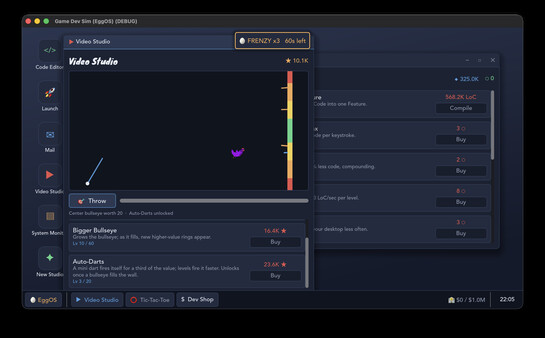
The Dev Shop is where raw output becomes product. Treat it as your conversion layer: Lines of Code flow in, Features come out, and the efficiency of that conversion determines how quickly a project comes together. Early on it is easy to hoard code without compiling; avoid this, since uncompiled code is not moving you toward a shippable game.
The Dev Shop is also where reinvestment decisions live. The game's structure rewards a classic incremental pattern — spend early earnings on upgrades rather than banking them, because each upgrade permanently raises your throughput. A slightly slower first project that funds strong upgrades will beat a rushed first ship followed by a slow grind.
As a rule of thumb for incremental games of this type, prioritize upgrades that multiply your passive generation over ones that only boost manual clicking. Manual play dominates the opening minutes, but the mid-game belongs to whoever set up their multipliers earliest.
Automation: The Coding AI and Auto-Compiler
EggOS's two flagship automation tools remove the human bottleneck from each half of the core loop. The Coding AI writes Lines of Code for you, turning code generation from an active clicking task into a passive income stream. The Auto-Compiler handles the Dev Shop side, converting code into Features continuously — as the game puts it, it never sleeps.
Getting both automations online should be an early priority, because together they close the loop entirely: code is generated, compiled, and stockpiled toward your next game without any input from you. This matters doubly because EggOS supports idle progress — the work keeps going while you are away from the game, so an automated studio earns even when the app is closed.
Automation also frees you to engage with EggOS's side activities — the dart-throwing, slot machine, and other mini-games scattered around the desktop — without stalling your main development pipeline. Think of automation as the point where you stop being the studio's only programmer and start being its manager.
Maximizing Revenue Per Project
Revenue per project is a function of throughput: the faster you can turn code into Features and Features into a finished game, the more games you ship per hour of play, and the faster the debt shrinks. That means the most profitable 'strategy' is usually not saving up for one perfect game, but tightening every stage of the pipeline so projects roll off the line continuously.
Reinvestment discipline is the biggest lever. Every upgrade purchased between projects compounds across all future projects, so the standard incremental-game principle applies: money spent on permanent production increases almost always outearns money left idle. Balance spending between code generation (Coding AI tiers), compilation speed (Auto-Compiler tiers), and any upgrades that improve the value of a shipped game itself.
Finally, factor idle time into your planning. Because progress continues offline, it is efficient to line up your automation and upgrades just before stepping away, then return to a stockpile of code and Features ready to be shipped. Long sessions of active play are for buying upgrades and pushing milestones; idle stretches do the raw accumulation for free.
Prestige: Rebuilding Your Studio Faster Every Time
Paying off the bank is not the end of EggOS — it is the trigger for its prestige layer. Starting fresh earns Prestige points, which are spent on a sprawling skill tree of permanent bonuses: flat multipliers to your output, head-starts that let a new run skip the slow opening phase, and game-changing perks that alter how the loop plays.
The prestige tree is where long-term coding efficiency really lives. A first run's painstaking climb from manual typing to full automation gets dramatically shorter once permanent multipliers and head-start perks are in place, and the game is explicitly built around this: every studio is faster than the last.
When choosing tree nodes, the same logic as in-run upgrades applies — favor permanent multipliers and head-starts that compress the early game, since that is the slowest, most manual phase of any run. Deep runs into the tree turn the original million-dollar grind into a warm-up lap, which is exactly the loop EggOS wants you chasing: beat the bank, reset, and do it all again, faster.