EggOS Beginner Guide — Your First Steps on the Fake Desktop
EggOS: Incremental Game Dev drops you onto a cheerful egg-themed fake desktop with one urgent email: the bank wants $1,000,000 or it takes your house. This beginner guide walks you through your first boot, your first Lines of Code, and the early upgrades that turn frantic key-mashing into a self-running game studio.
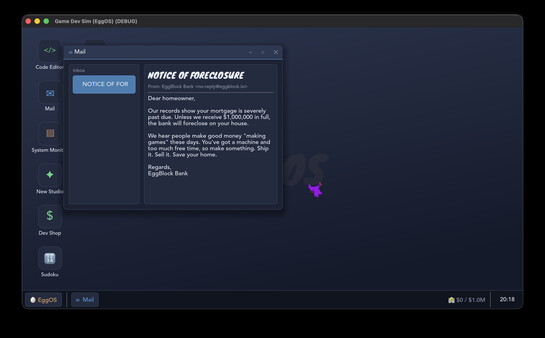
Booting EggOS and Reading the Bank's Email
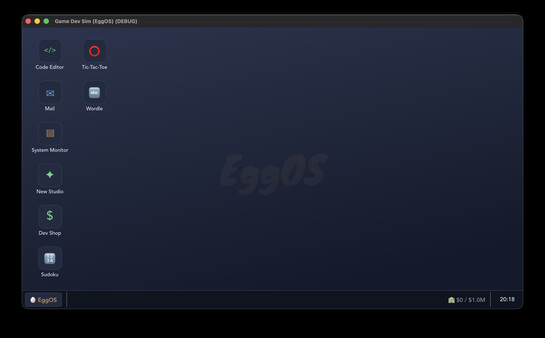
When you launch the game, you are not looking at a menu — you are looking at EggOS itself, a playable fake operating system styled like a cozy retro desktop. Everything you do in the game happens through its windows, icons, and apps, so your first task is simply to explore what is on the desktop and get comfortable opening and arranging programs.
The story kicks off with a single email waiting in your inbox: the bank is foreclosing on your house unless you can pay back one million dollars. That email is effectively your quest log for the entire run. Every dollar you earn from this point forward chips away at that debt, and paying it off is the win condition for your first playthrough.
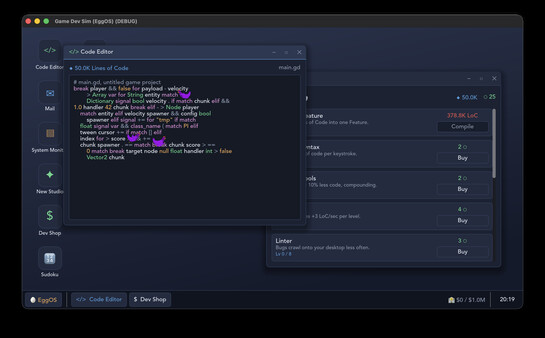
The only sensible response to a foreclosure notice, naturally, is to open the code editor and start making games. Money in EggOS comes from shipping games, and games come from code — so the core loop begins the moment you click into the Code Editor for the first time.
The Core Loop: Lines of Code, Features, and Shipped Games
The economy of EggOS runs on a simple production chain. In the Code Editor, you hammer the keyboard to generate Lines of Code — this is your basic clicker-style resource, and early on your typing is the only engine the studio has. Expect the opening minutes to be hands-on and a little frantic; that is by design, because the game wants you to feel the difference once automation arrives.
Raw code is not worth anything on its own. You take your Lines of Code into the Dev Shop and compile them into Features, the intermediate resource that actually goes into a product. Features are what let you eventually build and ship a complete game, and shipping games is how you earn the money the bank is demanding.
Think of the loop as a cycle rather than a straight line: write code, compile Features, ship a game, then pour the earnings back into the studio so the next game comes together faster. Reinvesting is almost always better than hoarding cash in the early game, because every upgrade compounds the speed of the whole chain.
Your First Upgrades: Coding AI and the Auto-Compiler
The single most important early milestone is automation. Two upgrades transform the game from a clicker into a true incremental: the Coding AI, which writes Lines of Code for you without any keyboard input, and the Auto-Compiler, which converts code into Features around the clock. Prioritize getting both online as soon as your budget allows.
Once automation is running, your role shifts from laborer to manager. Instead of hammering keys, you spend your time deciding where the next dollar goes — more output from the AI, faster compiling, or the other money-making apps scattered around the desktop, like the dart-throwing game and the slot machines that offer side income between shipments.
Automation also unlocks the idle half of the game: progress continues while you are away, so the studio keeps writing, compiling, and earning even when EggOS is closed. Before stepping away for a while, make sure your automation upgrades are purchased and your production chain has no bottleneck, so you return to a meaningful pile of resources rather than a stalled pipeline.
Prestige: Beat the Bank, Then Do It Again Faster
Paying off the million-dollar debt is not the end of EggOS — it is the gateway to the prestige system. When you start fresh, you earn Prestige points based on your run and spend them in a sprawling skill tree of permanent bonuses: multipliers that boost production forever, head-starts that skip the slowest early phases, and game-changing perks that alter how the studio works.
Because prestige bonuses are permanent, every subsequent studio is faster than the last. A grind that took your first run a long slog might fly by on your second, and the deep skill tree means there are many runs' worth of upgrades to chase. Do not be afraid to reset once your progress noticeably slows; a fresh start with new perks usually outpaces pushing a stalled run.
For your first prestige purchases, favor broad production multipliers and early-game head-starts over narrow situational perks. The opening minutes of each run are the slowest part of the loop, so anything that shortens the manual-typing phase pays dividends on every single reset that follows.
Beginner Tips for Your First Run
Explore the whole desktop early. EggOS hides several ways to make money beyond pure coding — dart-throwing, slot machines, and other mini-games all live as apps on the fake OS. The mini-games provide variety and extra cash while your automated coding pipeline works in the background, so rotating through them keeps your hands busy and your income diversified.
Watch for bottlenecks in the production chain. If Lines of Code are piling up faster than the Auto-Compiler can process them, your next purchase should improve compiling rather than code generation; if the compiler is starving, invest in the Coding AI instead. Balanced throughput earns more than maxing out a single stage.
Finally, remember that the first run is meant to be the slowest one you will ever play. Do not stress about a perfect route to the million dollars — focus on learning the apps, unlocking automation, and understanding the loop. Everything you learn carries into your prestige runs, where the real optimization game begins.