All Mini-Games Guide — Dart Throwing, Slot Machines & Hidden Games
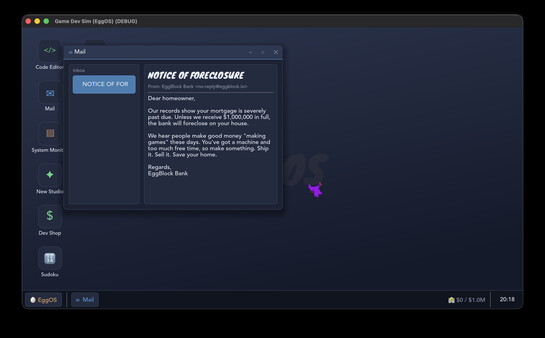
EggOS is more than a code editor and a looming bank deadline — scattered across its cheerful egg-themed desktop are mini-games like dart throwing and slot machines that offer alternate ways to earn money, break up the coding grind, and squeeze extra value out of every run. This guide covers how each mini-game works, how to unlock them, and when they are actually worth your time versus simply writing more Lines of Code.
How Mini-Games Fit Into the EggOS Loop
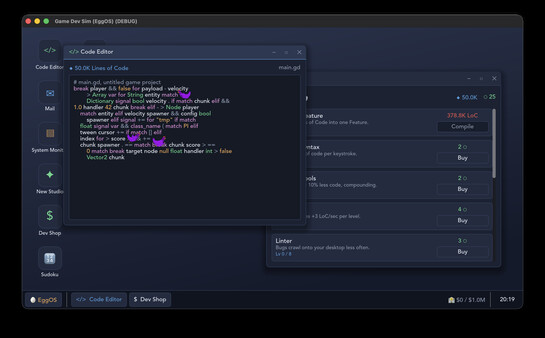
The core loop of EggOS revolves around hammering out Lines of Code in the Code Editor, compiling them into Features at the Dev Shop, and shipping games to chip away at the $1,000,000 the bank is demanding. Mini-games sit alongside this loop as optional applications on the fake desktop: they are diversions by design, but each one feeds back into your main economy in some way, whether through direct cash payouts, bonus resources, or simply keeping your hands busy while automation like the Coding AI and Auto-Compiler runs in the background.
The key mindset for mini-games is opportunity cost. Early in a run, before you have meaningful automation, every second spent at a slot machine is a second not spent generating code — so mini-games are best treated as a supplement, not a replacement. Once the Coding AI is writing for you and the Auto-Compiler is converting code into Features on its own, mini-games become nearly free value: your passive income keeps flowing while you play, so anything a mini-game pays out is pure profit on top.
Mini-games also matter across prestige resets. Because starting fresh earns Prestige points for a skill tree of permanent multipliers and head-starts, each new studio reaches the mini-game unlocks faster than the last. Veterans often fold mini-game sessions into their reset routine, using them to bridge the awkward early minutes of a run before automation comes back online.
Dart Throwing Guide
Dart throwing is the skill-based entry in the EggOS mini-game lineup. Unlike the purely idle systems that dominate the rest of the game, darts asks you to actually aim: your reward scales with how close to the center of the board you land, so this is one of the few places in EggOS where player execution directly changes your payout rather than just your click rate.
The practical advice is simple: take your time on each throw rather than spamming. Because the reward is accuracy-weighted, a slow string of near-bullseyes beats a fast string of edge hits. Treat your first several rounds as calibration — learn the timing and feel of the throw before you start caring about results, since the mini-game costs you nothing but time that your automation is already covering.
Dart throwing shines as an active-play option during stretches where your main loop is bottlenecked — for example, while you are saving up for an expensive upgrade in the Dev Shop and additional clicking would barely move the needle. Rather than idling at the Code Editor, swap to darts and convert that dead time into supplemental income.
Slot Machines Guide
The slot machines are EggOS's gambling outlet: you feed in money from your studio earnings, pull the lever, and hope the reels line up for a multiplied return. As with any slot mechanic, individual spins are pure chance — there is no timing trick or skill input, only a decision about how much of your bankroll you are willing to risk on variance.
Bankroll management is the whole game here. Never gamble money you have earmarked for a critical upgrade, an automation purchase, or your next loan payment to the bank; a cold streak at the wrong moment can set your run back badly. A sensible rule is to only spin with genuine surplus — cash sitting idle after you have bought everything currently worth buying. In that situation, a losing streak costs you nothing meaningful, while a jackpot can leapfrog you to your next big purchase early.
The value of the slots also shifts with your income curve. Early on, when every dollar is precious, the machines are a trap for impatient players. Late in a run — or in prestige-boosted runs where permanent multipliers have inflated your income — losses are trivially replaced by passive earnings, and the slots become a low-stakes way to gamble for spikes. If you enjoy the thrill, save it for when your idle income can absorb the downside.
Hidden Games and Desktop Secrets
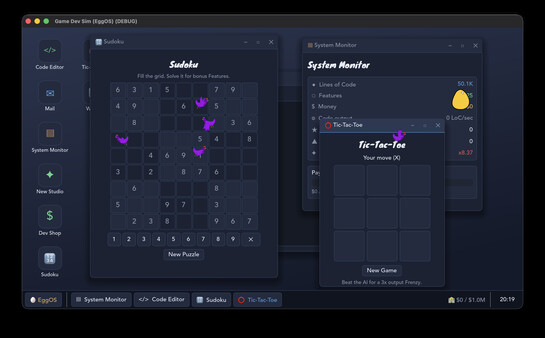
Part of EggOS's charm is that it behaves like a real operating system, and that means it hides things the way a real desktop does. Beyond the obvious application icons, the developers have tucked away additional unlockable activities and easter eggs for players who poke around. Make a habit of clicking on anything that looks interactive — icons, menus, decorative elements of the OS shell — because discoveries in EggOS often come from treating the fake desktop as a toy rather than a menu.
Hidden content in EggOS tends to surface as you progress: new applications and diversions appear as your studio grows, upgrades unlock, and prestige perks reshape what your desktop can do. If you notice a new icon after a milestone or a reset, open it — some of the game's mini-games are gated behind progression rather than sitting on the desktop from minute one. Checking the desktop after every major purchase or prestige is a cheap habit that ensures you never miss an unlock.
Because the prestige skill tree includes game-changing perks and head-starts, some players find that later runs expose content earlier or in altered forms. Exploring the OS thoroughly on each fresh studio is worthwhile even for veterans — the whole design philosophy of the game rewards curiosity.
When to Play Mini-Games: A Priority Strategy
A useful framework for the whole mini-game suite: active play early, mini-games mid-run, everything at once late. In the opening minutes of a studio, your manual clicking in the Code Editor is your best income source, so stay focused there and rush your first automation upgrades. Mini-games are a distraction at this stage, with the possible exception of quick dart sessions while waiting on a purchase.
Once the Coding AI and Auto-Compiler have taken over the grunt work, your attention is freed up and mini-games become the best use of your active time. Rotate between darts for reliable skill-based income and the slots for surplus-cash gambles, and periodically sweep the desktop for anything new that has unlocked. Because EggOS supports idle progress, the main loop keeps working even while you are mid-spin or mid-throw — you lose nothing by playing.
Finally, remember that everything funnels toward two goals: paying off the bank and building a stronger prestige position for the next run. Mini-game earnings are just another stream feeding that pipeline. If a mini-game session is fun, that is reason enough to play; if you are optimizing, play them only when automation is carrying your baseline income, and reinvest every payout into upgrades that compound. Beat the bank, reset, and each faster studio will get you back to the fun parts sooner.