EggOS: Incremental Game Dev Review — A Deep Dive Into the Fake Desktop Idle Game
EggOS: Incremental Game Dev, from codeWonderland Development, wraps a layered idle game inside a playable fake desktop operating system: the bank demands a million dollars, and your only way out is coding, marketing, and shipping games from a cheerful egg-themed OS. This review breaks down the core loop, the prestige system, the mini-game variety, and whether the whole package is worth your time.
Premise and Presentation: A Desktop You Actually Play Inside
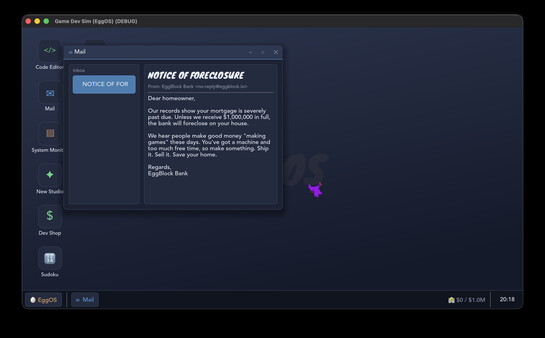
The setup is simple and effective. You boot into EggOS and find a single email waiting: the bank is foreclosing on your house unless you pay back $1,000,000. With nothing but a computer and free time, you open a code editor and start making games to earn your way out. That one clear goal — beat the bank before it takes your house — gives the whole run a sense of direction that many incremental games lack.
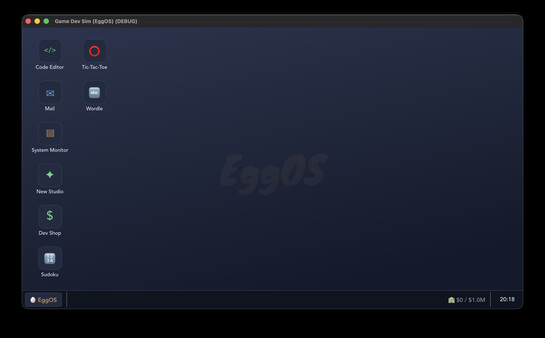
What sets EggOS apart from other idle games is that the operating system framing is not just a menu skin. The desktop is genuinely interactive, with draggable windows, a taskbar, notifications, and even a screensaver. The environment also fights back in small, playful ways: golden eggs appear and trigger score Frenzies when clicked, and bugs literally crawl across your desktop waiting to be swatted. These touches make the screen feel alive between upgrade purchases and reward players who stay attentive rather than purely idle.
Visually and tonally, the game leans into casual charm rather than spreadsheet austerity. It reads as a lighthearted simulation of indie game development, and the egg theme is committed to throughout, from the OS branding down to the desktop critters.
The Core Loop: Code, Market, Launch, Sell
The gameplay loop follows a clear pipeline: code, then market, then launch, then sell, then prestige. It starts in the Code Editor, where you hammer the keyboard to churn out Lines of Code. Those lines are compiled into Features in the Dev Shop, and Features are what eventually let you build and ship a finished game. Early on this is hands-on clicker territory, but reinvesting your earnings quickly changes the texture of play.
Automation arrives in the form of upgrades like a Coding AI that writes code for you and an Auto-Compiler that never stops working. This is the classic incremental arc — active input giving way to managed systems — and EggOS handles the transition smoothly. Idle and offline earnings are supported, so progress continues while the game is closed, and the store's own framing of the game as playable at your own pace holds up in practice.
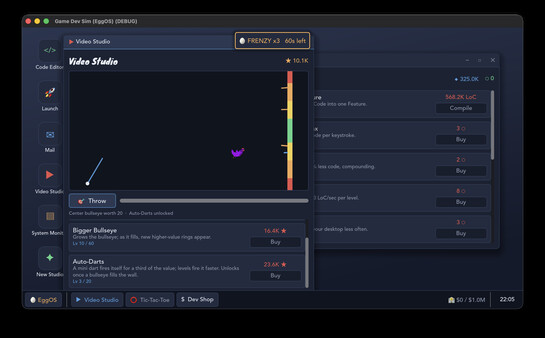
Once a game is built, the loop shifts from production to commerce. The Video Studio, a physics-based dart-throwing range, generates Wishlists when you hit the growing bullseye. Launching your game spends those Wishlists to release it to the world, and the Sales Floor — a three-reel slot machine — converts the resulting hype into cash. Money then flows back into upgrades and, crucially, toward that looming million-dollar debt.
Mini-Games: More Than Number-Go-Up
The strongest argument for EggOS over a conventional idle game is that its key production steps are real mini-games rather than passive bars filling up. Marketing is a genuine dart-throwing challenge with physics, where accuracy against a growing bullseye directly translates into Wishlists. Sales run through a slot machine, adding a burst of casino-style variance to the payout phase. Neither activity is deep on its own, but both give your hands something meaningful to do while the incremental engine hums underneath.
Beyond the core pipeline, the desktop is stocked with bite-sized side games: Tic-Tac-Toe, Sudoku, Wordle, and a Slide Puzzle. These are familiar diversions rather than reinventions, and they fit the fake-OS fantasy well — they feel like the little bundled applications you would actually poke at on a real desktop while procrastinating. Combined with the golden-egg Frenzies and bug-swatting, there is almost always an optional activity on screen.
The variety does the important work of pacing. Incremental games often sag in the mid-game while waiting for the next upgrade threshold; in EggOS, those waits can be spent throwing darts for Wishlists, spinning the Sales Floor, or clearing a Sudoku, which keeps sessions feeling active rather than idle in the pejorative sense.
Prestige Depth: Open a New Studio
Prestige in EggOS is framed as opening a new studio. Resetting your run earns Prestige points, which are spent on a sprawling skill tree of permanent multipliers, head-starts, and perks that change how subsequent runs play out. The design intent is explicit: every studio should be faster than the last, and the stacking multipliers make early-game phases that once took real effort collapse into minutes on later resets.
The skill tree is where the long-term decision-making lives. Choosing between raw multipliers, head-start bonuses that skip early friction, and game-changing perks gives each reset a planning phase, and the layered structure means the million-dollar target that defined your first run becomes a stepping stone rather than a finish line. For players who enjoy optimizing reset timing and route-planning through prestige trees, this is the meat of the game.
Steam's achievement list mirrors the arc of a full run — launching a game, amassing Wishlists, and finally paying off the bank — so completion-minded players have clear milestones. With save-anytime support and Steam Cloud, dipping in and out across sessions and machines is frictionless.
Verdict: Who Is EggOS For?
EggOS: Incremental Game Dev is an easy recommendation for incremental and idle fans who want more tactile involvement than the genre usually offers. The fake-desktop conceit is executed with real commitment, the code-market-launch-sell pipeline gives the numbers a narrative shape, and the prestige tree provides the long-tail depth that keeps the genre's devotees coming back. It is a budget-priced, single-player casual game available on Windows, Mac, and Linux, with a free demo available for anyone who wants to test the loop before buying.
The caveats are mostly about expectations. The mini-games are charming but simple — darts, slots, and classic puzzles rather than deep systems — and players who dislike any luck-based element may bristle at the slot-machine sales phase. Likewise, anyone seeking a serious game-development simulator should look elsewhere; this is an incremental game wearing a dev-studio costume, not a management sim.
Taken on its own terms, though, EggOS delivers exactly what its pitch promises: make games, beat the bank, then do it all again, faster. If that loop sounds appealing, the playful presentation and layered prestige system make it one of the more personality-rich entries in the incremental genre.